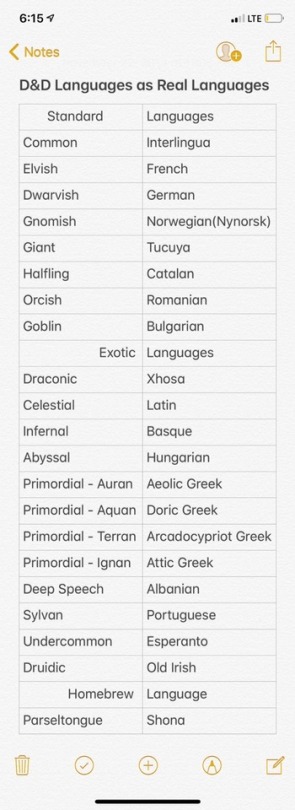
After seeing that post that basically suggests Common is a language like Esperanto I couldn’t stop thinking about what the other languages would be
I did this after finding Milori’s Guide to Language’s (created by a linguist and available on DMs Guild for free). It’s obviously not canonically accurate, but it’s written in character and was just a fun read (cos I’m a nerd who loves linguistics).
After seeing that post that basically suggests Common is a language like Esperanto I couldn’t stop thinking about what the other languages would be
I did this after finding Milori’s Guide to Language’s (created by a linguist and available on DMs Guild for free). It’s obviously not canonically accurate, but it’s written in character and was just a fun read (cos I’m a nerd who loves linguistics).
My group just uses dice from each player’s set to represent their characters and assorted mini dice for everything else. You could even use bits of Lego pieces if you’d like.
Though if you have the option, getting figurines made through HeroForge is another option to consider. I plan on getting my own 3D printer and simply buying the designs and printing my own.
Hero forge allows you to buy the .stl files so you can print them many times, in case you want to change coloring, take some over to a friends house, break one, or just have 100 versions of this one goblin. Cheaper than buying one, if you have the Printer access. Definitely cheaper than buying multiple copies.
Also much faster, because you aren’t waiting a few weeks for it to come in.
That’s the idea behind printing them if you have a printer, though it’s getting a 3D printer that’s the real expensive part.
I’ve reblogged this before, but something I’ve just thought of is a lot of public libraries now have 3D printers. At mine it costs 10¢ per gram to 3D print (which is the same as regular printing per page). You just bring them the .stl file (or pull it up online) and they’ll print it.
Make sure the system you use matches the kind of players you have, for an optimal experience
Admin Note: This is part of the ongoing series called “D&D isn’t the only TTRPG if you don’t want fantasy play another goddamn game!”
I already reblogged this once but this is important:
Like I run a D&D blog. I understand that D&D is the most well-known and popular RPG in the world. But a lot of the time I see people going like “Hey I want to run a D&D campaign and throw out all the D&Disms and here’s all the notes I have for running a campaign about courtly romance and chivalry in a historical setting” and I’m just like STOP YOU DON’T NEED TO RUN THIS USING D&D
There’s a sort of a mistaken assumption that because D&D is the biggest game on the market and that it’s fantasy that it should be the go-to fantasy game but look it’s not D&D isn’t a generic fantasy game it’s a very specific kind of fantasy all of its own, one that steals liberally from swords & sorcery and high fantasy and adds fucking extradimensional cube robots for good measure
So next time you’re thinking about a fantasy campaign in a decidedly non-D&Dish setting consider instead of jamming the square peg that is D&D into a round hole trying to find a system that actually supports what you’re trying to do
And this is not to say that you shouldn’t play D&D: D&D is hella fun. But there’s a lot of genres and styles that D&D does a piss-poor job of doing, and because of that it’s so good we’ve got other games
*cracks knuckles*
All right then. I’ve been meaning to dust off my own D&D sideblog for a while, so here we go with providing some examples. I’m limiting this specifically to other types of fantasy outside of the standard high fantasy and sword & sorcery millieu.
Courtly Romance and Chivalry
There are a number of options for this, and they range from standard secondary world fantasy to more historical and mythological settings. My list here shouldn’t be treated as fully extensive.
Blue Rose – based on the romantic fantasy subgenre, specifically as seen in the works of Tamora Pierce and Mercedes Lackey. A lot of courtly drama and intrigue and swashbuckling, based in a fictional world.
Pendragon – naturally based off of Arthurian mythology, and having a lot of stuff given over to the court of Camelot and the chivalric adventures of the various knights. The same company also has a kickstarter for a spin-off called Paladin: Warriors of Charlemagne that might be worth checking out.
Historical Fantasy
This one’s a bit more prominent as historical settings serve as an inspiration for a variety of fantasy worlds and games, and this of course invariably extends to settings that actually use historical settings with a degree of fantasy elements thrown in. Note that I’m going to emphasise Europe here simply due to greater familiarity with games in that millieu, and as a European myself I’m ill-equipped to judge how accurate or respectful games using other settings actually are.
Because of this, feel free to add other examples in reblogs
Chivalry & Sorcery – one of the early tabletop games inspired by D&D, taking a more pseudo-historical approach.
It’s based on 12th century France and strives for a degree of historical accuracy and medieval politics.
World of Darkness, Dark Ages (including Vampire and Mage) – while the World of Darkness has earned some negative attention lately (and for good reason), the dark ages RPGs are still an old favourite of mine. Also worth checking out is Mage: The Sorcerer’s Crusade, set during the Renaissance. The Mage stuff has a really cool open-ended magic system worth checking out.
Ars Magica – this exists along very similar lines to the dark age material above, based around mages and magic-users in a ‘Mythic Europe’ setting. It also has a really cool open-ended magic system, and one of my personal favourites.
Awwww shit heck yes I might want to add to this list but this is a really good starting point




 Verliese Und Drachen